Friday, July 29, 2011
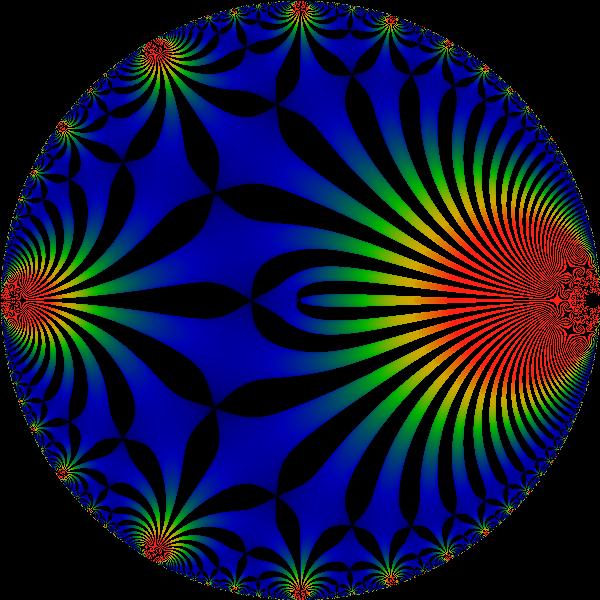
Stability and chaos are analyzed by computing the Lyaponuv exponent which is plotted above.
Friday, July 15, 2011
A generalization of the Cornu spiral, this is an example of a polynomial spiral described by Dillen (1990) for which the curvature is a polynomial function of the arc length.
Tuesday, July 12, 2011
Sunday, July 10, 2011
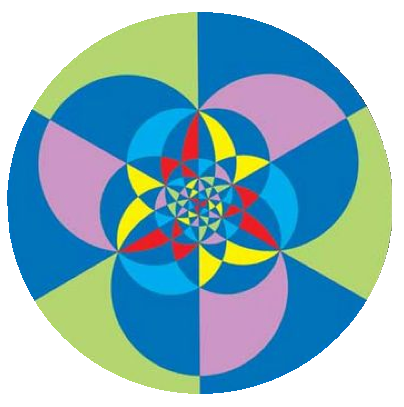
Zach Kron writes an interesting post about this image, which is created by using several layers of a very basic shape repeated in a pattern and then varying the size and angles, and seems to show up a lot on ceilings and walls of buildings.
Tuesday, July 5, 2011
Sunday, July 3, 2011
An interesting new look at the Menger sponge: slicing the sponge at an angle produces six-sided stars. One of the proposed exhibits for the Museum of Mathematics, MOMATH.
Thursday, June 23, 2011
Using different values of a and b, the equations
x(t) = sin(t/2) - a*sin(bt)cos(t)
y(t) = cos(t/2) - a*sin(bt)sin(t)
produce images such as the ones above.
By Herbert Franke
Friday, June 17, 2011
Friday, June 10, 2011
Sunday, June 5, 2011
Friday, May 20, 2011
Sunday, May 15, 2011
A moiré pattern is an interference pattern created by overlaying two or more grids at an angle. The moiré pattern above is by Jacob Yerex.
Tuesday, May 10, 2011
Thursday, May 5, 2011
Above are Cayley graphs of a finite Coxeter group on four generators embedded into the 3-sphere and then projected onto Euclidean space. If we could see these images in the hypersphere, the curved lines would be straight. More here.
Tuesday, April 26, 2011
A closed meander of order 120: a closed curve that intersects a line at 120 points, without intersecting itself.
Thursday, April 14, 2011
A polyhedron constructed by folding along the edges of a Spidron - a figure in the plane made up of two alternating sequences of isosceles triangles.
Monday, April 11, 2011
Sunday, April 10, 2011
This is a Klein diagram by Francisco Lara-Dammer that represents A5, the group of symmetries of the icosahedron.
A pattern showing the result of six levels of recursion using the "inflation rules" of Penrose tiles. By L. Kerry Mitchell.
Thursday, April 7, 2011
Kürschák's Dodecagon
A visual proof by Kürschák that a regular 12-sided polygon inscribed in the unit circle has area 3. This means that estimating π to be 3 is like saying a circle is a Dodecagon.
Labels:
equal areas,
pi,
polygons,
unit disc,
visual proof
Tuesday, April 5, 2011
Tuesday, March 29, 2011
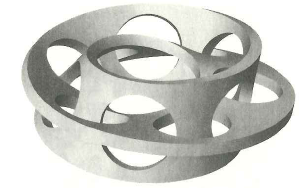
A Mobius-like object with holes by Tom Longtin and Rinus Roelofs.
Tuesday, March 22, 2011
Circle packings
Circle packing is a study of arranging a maximal number of different sized circles (or spheres) so that none overlap. In the picture above, circles of the same size have the same color. See more here.
Wednesday, March 9, 2011
Tuesday, March 8, 2011

The colors represent the amplitude of the ground's horizontal motion 6 seconds into a 4.4-magnitude earthquake. This image produced on a supercomputer in Pittsburgh is one of several such simulations whose accuracy provides architects with localized information on the kind of intensity buildings may have to withstand.
This is one of many beautiful supercomputer simulations compiled by Discover.
Subscribe to:
Posts (Atom)