Tuesday, August 30, 2011

I just finished watching "Between the Folds," a documentary on origami and paper folding by Vanessa Gould, and was blown away by some of the amazing works and artists in the film. One of my favorites was Chris Palmer, whose works are about movement and light.
This video is inspired by some of his other pieces:

Thursday, August 25, 2011

An image from an awesome demo by Ed Pegg Jr. that's part of the Wolfram Demonstrations Project. This image corresponds to Gaussian integers raised to the 11th power. The demo allows one to view Gaussian integers raised to any fractional power. The user can choose a numerator and denominator less than 20.

Gaussian integers raised to the 17/6 th power

Sunday, August 14, 2011

Saturday, August 13, 2011

This image by Gabriel Doyle is a representation of the universal cover of the doubly-pointed Heegaard diagram of genus 1 of a (1,1)-knot.
"Octopod" by Syntopia (Mikael Hvidtfeldt Christensen) is an example of algorithmic art.
"In algorithmic art the creative design is the result of an algorithmic process, usually using a random or pseudo-random process to produce variability."

Saturday, August 6, 2011

A Lorenz attractor by Nathan Selikoff, titled "Butterfly Effect."
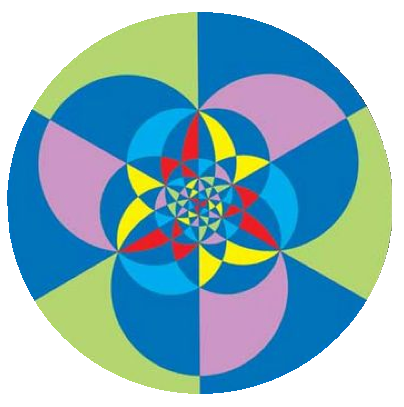
"Equal Areas" by Susan McBurney.
This image, inspired by Leonardo DaVinci, builds upon a concept of equal areas. The sum of the areas of the red shapes in the bordering semicircles is equal to the sum of the areas of the red shapes inside the center circle; and the same goes for the green, yellow, pink, and peach shapes.
"Knot Structured" by George W. Hart was made by assembling 30 identical pieces of laser-cut wood. Read more here.

Friday, July 29, 2011

Stability and chaos are analyzed by computing the Lyaponuv exponent which is plotted above.

Friday, July 15, 2011

A generalization of the Cornu spiral, this is an example of a polynomial spiral described by Dillen (1990) for which the curvature is a polynomial function of the arc length.
Klein's j-invariant in the complex plane
A plot of z = |W(x+iy)|, where W is the Lambert W function

Sunday, July 10, 2011

Point collections by Zach Kron
Zach Kron writes an interesting post about this image, which is created by using several layers of a very basic shape repeated in a pattern and then varying the size and angles, and seems to show up a lot on ceilings and walls of buildings.

Sunday, July 3, 2011

An interesting new look at the Menger sponge: slicing the sponge at an angle produces six-sided stars. One of the proposed exhibits for the Museum of Mathematics, MOMATH.

Thursday, June 23, 2011


Using different values of a and b, the equations
x(t) = sin(t/2) - a*sin(bt)cos(t)
y(t) = cos(t/2) - a*sin(bt)sin(t)
produce images such as the ones above.

By Herbert Franke

Sunday, May 15, 2011

A moiré pattern is an interference pattern created by overlaying two or more grids at an angle. The moiré pattern above is by Jacob Yerex.
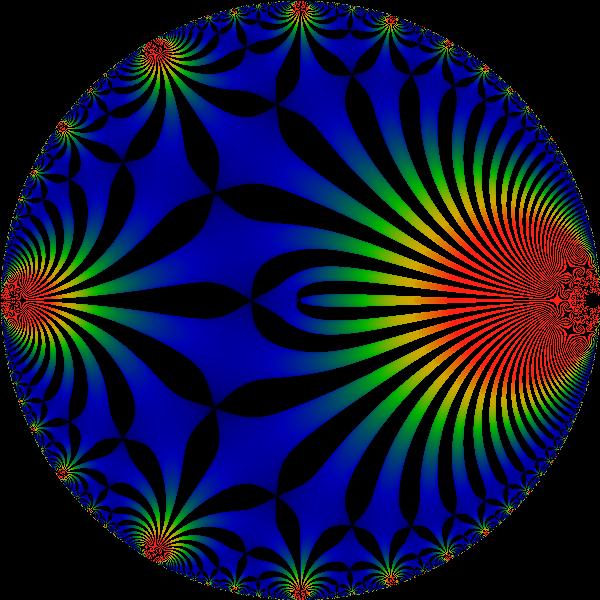
The Dedekind Tessellation: a tessellation of the half-plane in hyperbolic triangles.

Thursday, May 5, 2011


Above are Cayley graphs of a finite Coxeter group on four generators embedded into the 3-sphere and then projected onto Euclidean space. If we could see these images in the hypersphere, the curved lines would be straight. More here.
Particles colliding in a particle accelerator

Tuesday, April 26, 2011

Thursday, April 14, 2011

A polyhedron constructed by folding along the edges of a Spidron - a figure in the plane made up of two alternating sequences of isosceles triangles.

Sunday, April 10, 2011

A strange attractor by Nathan Selikoff resembling the Eagle Nebula.
Part of a tessellation of the plane generated using Möbius transforms. By Doug Hensley.
Some examples of Chladni patterns
A rhombic triacontahedron and its net
This is a Klein diagram by Francisco Lara-Dammer that represents A5, the group of symmetries of the icosahedron.
A strange attractor by Nathan Selikoff.
Impossible Geometry by Jos Leys
A pattern showing the result of six levels of recursion using the "inflation rules" of Penrose tiles. By L. Kerry Mitchell.

Thursday, April 7, 2011

Kürschák's Dodecagon
A visual proof by Kürschák that a regular 12-sided polygon inscribed in the unit circle has area 3. This means that estimating π to be 3 is like saying a circle is a Dodecagon.